Visualizzazione post con etichetta stemma Diocesi Corpus Christi. Mostra tutti i post

lunedì 30 ottobre 2017

Mulvey, William Michael (1949- ), vescovo

William Michael Mulvey
Vescovo di Corpus Christi (2010- )

Sententia in Christo vobis

02

Riferimenti: biografici
scheda di www.catholic-hierarchy.org
pagina di en.wikipedia.org

Riferimenti araldici
stemma della Diocesi di Corpus Christi

Fonti immagini
01 pagina di lh6.googleusercontent.com
02 pagina di diocesecc.org Lo stemma e il motto sono così presentati nella pagina di www.diocesecc.org:
For his personal coat of arms, Bishop Wm. Michael Mulvey has adopted a design that reflects his heritage and his ministry as a priest of Jesus Christ. The upper portion of Bishop Mulvey’s insignia is a field of gold with a red escallop (Scallop shell) displayed upon it.  This is taken from the arms of His Holiness, Pope Benedict XVI, who called the bishop to the fullness of Christ’s priesthood as a bishop. The shell is also a symbol of baptism and the journey of holiness to which all are called.  
The lower portion of the design has two blue lions that are taken from the Mulvey family coat of arms.  The blue wavy bar across the center of the design represents the Colorado River that runs through the Diocese of Austin.  It is taken from the arms of that diocese, the home diocese of Bishop Mulvey and the people of God he served for 35 years in many capacities, including as the diocesan administrator.  
The three silver stars signify the heritage of Bishop Mulvey’s mother as well as the Most Holy Trinity.  For his motto, Bishop Mulvey selected the phrase “Sententia in Christo Vobis.”  This Latin phrase, derived from St. Paul’s letter to the Philippians (Phil 2:5), means essentially “have the same attitude in yourselves as is found in Christ” and expresses the bishop’s deep belief that in order to be a man of communion, our hearts must be moved by the same sentiments that moved the heart of Christ Jesus in his life and mission.   

Carmody, Edmond (1934- ), vescovo

Edmond Carmody
Vescovo ausiliare di San Antonio (1988-1992)
Vescovo titolare di Mortlach (1988-1992)
Vescovo di Tyler (1992-2000)
Vescovo di Corpus Christi (2000-2010)
Vescovo emerito di Corpus Christi (2010- )

With Christ all is Possibile

Riferimenti: biografici
scheda di www.catholic-hierarchy.org
pagina di en.wikipedia.org

Riferimenti araldici
stemma della Diocesi di Corpus Christi

Fonti immagini
pagina di lh5.googleusercontent.com

Lo stemma e il motto sono così presentati nella pagina di www.diocesecc.org:
The shield of Bishop Edmond Carmody symbolizes his family, his priestly and missionary service and his devotion to the people, especially to the poor.  The green shield in the upper left corner of the bishop’s coat of arms is the color of hope and stands for his birthplace, Ireland.  The gold cross that divides his shield is taken from the papal shield of Pope John Paul II and shows the bishop’s union with Rome and solidarity with the Holy Father.  
In the upper right side of the shield is a silver star on a blue field.  As with the coat of arms of former bishops of Corpus Christi, this star denotes the state of Texas, the site of his priestly vocation and episcopal ministry.  The sprouting oak stump comes from the Carmody family crest and recalls the strength of the oak, its roots in the earth, that even though cut down to the stump is capable of generating new life. The green leaves signify new hope and life. The red of the background is for courage, readiness to suffer for the faith, even as the Carmody ancestors once were persecuted and martyred for their faith.  Finally, next to the oak can be seen a condor in gold with red beak and claws on a field of green.  
This majestic bird of the Andes represents Bishop Carmody’s five years of missionary service in Ecuador as a member of the Society of St. James the Apostle.  The bird is strong, graceful and high flying.  It is a near relative to Bishop Roberto O. González Nieves and also on the crest of the Carmody family.  The red claw and beak is a sign of struggle, especially the struggle for independence by the Irish and the Ecuadorian people.  By this sign the bishop seeks to ally himself with the poor and the powerless to defend and protect.  
Unlike previous bishops, Bishop Carmody chose to express his motto in English—“With Christ all is Possible.”   These words represent the bishop’s desire to be the instrument of Christ’s power going out to others, offering hope that is necessary to bring about needed change in people, society and the world

Gracida, René Henry (1923- ), vescovo

René Henry Gracida
Vescovo ausiliare di Miami (1971-1975)
Vescovo titolare di Masuccaba (1971-1975)
1° Vescovo di Pensacola-Tallahassee (1975-1983)
Vescovo di Corpus Christi (1983-1997)
Vescovo emerito di Corpus Christi (1997- )

Abyssus abyssum invocat

Riferimenti: biografici
scheda di www.catholic-hierarchy.org
pagina di en.wikipedia.org

Riferimenti araldici
stemma della Diocesi di Corpus Christi

Fonti immagini
pagina di www.diocesecc.org

Lo stemma e il motto sono così presentati nella pagina di www.diocesecc.org:
The personal insignia of Bishop Rene H. Gracida depicts a series of blue and silver lozenges from the coat of arms of St. Vincent Benedictine Archabbey at Latrobe, Pennsylvania, where the bishop studied for the priesthood.  The blue and silver diamonds give witness to the Bavarian origins of Abbot Boniface Wimmer under whose leadership at Latrobe the Benedictine Order grew in the United States.
The palm tree and the two crosses are taken from the coat of arms of the Archdiocese of Miami where Bishop Gracida was serving as Vicar General at the time of his call to the episcopacy. The two parts of his shield thus serve to identify the ecclesiastical lineage of the bishop both with regard to his priesthood and his episcopacy.  His motto, “Abyssus Abyssum Invocat,” taken from Psalm 41:8 (Vulgate), is translated “Deep is calling to deep” and expresses the program and spirit of the bishop who from the depth of his heart seeks to hear the word that comes from the heart of the Lord that His will may be done.

Drury, Thomas Joseph (1908-1992), vescovo

Thomas Joseph Drury
1° Vescovo di San Angelo (1961-1965)
Vescovo di Corpus Christi (1966-1983)
Vescovo emerito di Corpus Christi (1983-1992)

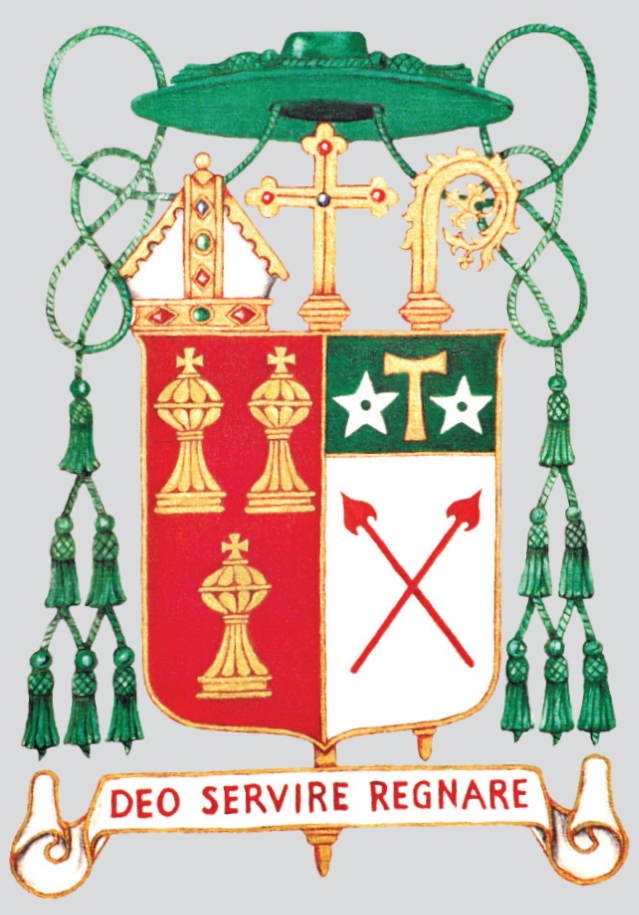
Deo servire regnare

Riferimenti: biografici
scheda di www.catholic-hierarchy.org
pagina di en.wikipedia.org

Riferimenti araldici
stemma della Diocesi di Corpus Christi

Fonti immagini
pagina di www.diocesecc.org

Lo stemma e il motto sono così presentati nella pagina di www.diocesecc.org:
The coat of arms prepared for Bishop Thomas J. Drury when he was consecrated a bishop is made up of a silver field with a green upper partition, bearing a Tau cross and stars, signifying his Irish ancestry as a son of County Sligo.  In the principal portion are two crossed lances.  As the reported instruments of martyrdom of St. Thomas the Apostle, the baptismal patron of Bishop Drury, the lances are tinctured in red, the liturgical color of martyrdom (blood).  The lances also form the Greek letter “Chi,” the initial letter of “Christ,” for whom St. Thomas offered his life.
His motto “Deo Servire Regnare” was taken from the Post-Communion of the Votive Mass for Peace at the time of his consecration as a bishop and is translated “To Serve God is to reign.”
 

Garriga, Mariano Simon (1886-1965), vescovo

Mariano Simon Garriga
Vescovo coadiutore di Corpus Christi (1936-1949)
Vescovo titolare di Siene (1936-1949)
Vescovo di Corpus Christi (1949-1965)

Sub tutela Matris

Riferimenti: biografici
scheda di www.catholic-hierarchy.org
pagina di en.wikipedia.org

Riferimenti araldici
stemma della Diocesi di Corpus Christi

Fonti immagini
pagina di www.diocesecc.org

Lo stemma e il motto sono così presentati nella pagina di www.diocesecc.org:
To the right in the coat of arms is the personal seal of Bishop Garriga.  The laurel tree was a symbol of Barcelona, and “La Garriga” is a municipality in that area of Spain from which Bishop Garriga’s father came.
The star at the top of the tree represents Our Lady “Star” of the Sea—the parish church in Port Isabel, Texas where Bishop Garriga was baptized.  It also points to the Lone Star State of Texas and is a reminder that Garriga was the first native Texan ordained a bishop in the state.  His motto “Sub Tutela Matris” emphasizes his great devotion to Mother Mary—“Under the protection/guard/guidance of Mother.”


Ledvina, Emmanuel Boleslaus (1868-1952), vescovo

Emmanuel Boleslaus Ledvina
Vescovo di Corpus Christi (1921-1949)
Vescovo titolare di Pitane (1949-1952)

Passio Christi in cordibus nostris

Riferimenti: biografici
scheda di www.catholic-hierarchy.org
pagina di en.wikipedia.org

Riferimenti araldici
stemma della Diocesi di Corpus Christi

Fonti immagini
pagina di www.diocesecc.org

Lo stemma e il motto sono così presentati nella pagina di www.diocesecc.org:
The cross at top is a variation of the cross of St. George and can attest to the bishop’s heritage since the Basilica of St. George in Prague was founded in 920 and was the original burial site of the early Czech martyrs and royal dynasties.  It was intended to be the main sanctuary in Bohemia, where Bishop Ledvina’s father was born.  However, this particular cross consists of a silver field, with a cross of red and blue.  In heraldry “silver” always replaces “white.”  The red, white, and blue cross signifies the Extension Society (of which Bishop Ledvina had been an officer for many years) and its service to the American home missions.
Below the cross are the lilies of France reminding us that Bishop Ledvina was ordained for the Diocese of Vincennes (now the Archdiocese of Indianapolis) a territory settled by the French missionaries and explorers like Joillet and Marquette.  The Carpenter’s Square signifies Bishop Ledvina’s father who was an architect and construction engineer.  Significantly the bishop himself was also known as the “Great Builder” because of the number of churches, convents, rectories and schools he built during his administration–including the present Corpus Christi Cathedral.  The star is the symbol of the Lone Star State as well as a symbol for the Blessed Virgin (Star of the Sea) and rests on a field of blue–the color of water and of the Blessed Mother.  His motto “In Domino Confido” expresses his strong faith in what can be done when we act with God–“I trust in the Lord.”

Nussbaum, Paul Joseph, C.P. (1870-1935), vescovo


Paul Joseph (Henry John) Nussbaum
Congregazione della Passione di Gesù (Passionisti)
1° Vescovo di Corpus Christi (1913-1920)
Vescovo titolare di Gerasa (1920-1922)
Vescovo di Sault Sainte Marie and Marquette (1922-1935)

Passio Christi in cordibus nostris

Riferimenti: biografici
scheda di www.catholic-hierarchy.org
pagina di en.wikipedia.org

Riferimenti araldici
stemma della Diocesi di Corpus Christi

Fonti immagini
pagina di www.diocesecc.org

Lo stemma e il motto sono così presentati nella pagina di www.diocesecc.org:
The coat of arms of Bishop Nussbaum which appears in the stain glass “The Manna in the Desert” contains on the left side the coat of arms of the newly erected Diocese of Corpus Christi–three ciborium (the vessels for holding the Eucharistic Body of Christ) on a field of red that represent the sacrifice of Christ who gave himself Body, Blood, Soul and Divinity in the Eucharist.
To the right on the seal is Bishop Nussbaum’s coat of arms.  The top half of his seal holds the symbol of the Passionist Congregation of which he was a member.  This symbol chosen by St. Paul of the Cross, founder of the Passionist Congregation, includes the branches of the palm and olive.  The palm branch is a reminder of the Passion of Christ and his victory over sin and death.  The olive branch is a reminder of his title as the Christ (the anointed one) since olive oil was used to make chrism by which the chosen were anointed.  Inside the heart (surmounted by a cross) are the words “Jesu XPI (short for “Christi”) Passio”, i.e. the Passion of Jesus Christ.
The lower half of Bishop Nussbaum’s personal coat of arms contains a “walnut tree”—the meaning of his name “Nussbaum” (remember the Christmas carol “O Tannenbaum”—a “fir tree” and hence the kind of evergreen tree used for a Christmas tree).  The motto of Bishop Nussbaum, “Passio Christi in Corporibus Nostris” refers to the words of St. Paul and reminds the members of the Passionist Congregation that we bear “the passion of Christ in our bodies”.