Visualizzazione post con etichetta Corpus Christi. Mostra tutti i post

lunedì 30 ottobre 2017

Mulvey, William Michael (1949- ), vescovo

William Michael Mulvey
Vescovo di Corpus Christi (2010- )

Sententia in Christo vobis

02

Riferimenti: biografici
scheda di www.catholic-hierarchy.org
pagina di en.wikipedia.org

Riferimenti araldici
stemma della Diocesi di Corpus Christi

Fonti immagini
01 pagina di lh6.googleusercontent.com
02 pagina di diocesecc.org Lo stemma e il motto sono così presentati nella pagina di www.diocesecc.org:
For his personal coat of arms, Bishop Wm. Michael Mulvey has adopted a design that reflects his heritage and his ministry as a priest of Jesus Christ. The upper portion of Bishop Mulvey’s insignia is a field of gold with a red escallop (Scallop shell) displayed upon it.  This is taken from the arms of His Holiness, Pope Benedict XVI, who called the bishop to the fullness of Christ’s priesthood as a bishop. The shell is also a symbol of baptism and the journey of holiness to which all are called.  
The lower portion of the design has two blue lions that are taken from the Mulvey family coat of arms.  The blue wavy bar across the center of the design represents the Colorado River that runs through the Diocese of Austin.  It is taken from the arms of that diocese, the home diocese of Bishop Mulvey and the people of God he served for 35 years in many capacities, including as the diocesan administrator.  
The three silver stars signify the heritage of Bishop Mulvey’s mother as well as the Most Holy Trinity.  For his motto, Bishop Mulvey selected the phrase “Sententia in Christo Vobis.”  This Latin phrase, derived from St. Paul’s letter to the Philippians (Phil 2:5), means essentially “have the same attitude in yourselves as is found in Christ” and expresses the bishop’s deep belief that in order to be a man of communion, our hearts must be moved by the same sentiments that moved the heart of Christ Jesus in his life and mission.   

Carmody, Edmond (1934- ), vescovo

Edmond Carmody
Vescovo ausiliare di San Antonio (1988-1992)
Vescovo titolare di Mortlach (1988-1992)
Vescovo di Tyler (1992-2000)
Vescovo di Corpus Christi (2000-2010)
Vescovo emerito di Corpus Christi (2010- )

With Christ all is Possibile

Riferimenti: biografici
scheda di www.catholic-hierarchy.org
pagina di en.wikipedia.org

Riferimenti araldici
stemma della Diocesi di Corpus Christi

Fonti immagini
pagina di lh5.googleusercontent.com

Lo stemma e il motto sono così presentati nella pagina di www.diocesecc.org:
The shield of Bishop Edmond Carmody symbolizes his family, his priestly and missionary service and his devotion to the people, especially to the poor.  The green shield in the upper left corner of the bishop’s coat of arms is the color of hope and stands for his birthplace, Ireland.  The gold cross that divides his shield is taken from the papal shield of Pope John Paul II and shows the bishop’s union with Rome and solidarity with the Holy Father.  
In the upper right side of the shield is a silver star on a blue field.  As with the coat of arms of former bishops of Corpus Christi, this star denotes the state of Texas, the site of his priestly vocation and episcopal ministry.  The sprouting oak stump comes from the Carmody family crest and recalls the strength of the oak, its roots in the earth, that even though cut down to the stump is capable of generating new life. The green leaves signify new hope and life. The red of the background is for courage, readiness to suffer for the faith, even as the Carmody ancestors once were persecuted and martyred for their faith.  Finally, next to the oak can be seen a condor in gold with red beak and claws on a field of green.  
This majestic bird of the Andes represents Bishop Carmody’s five years of missionary service in Ecuador as a member of the Society of St. James the Apostle.  The bird is strong, graceful and high flying.  It is a near relative to Bishop Roberto O. González Nieves and also on the crest of the Carmody family.  The red claw and beak is a sign of struggle, especially the struggle for independence by the Irish and the Ecuadorian people.  By this sign the bishop seeks to ally himself with the poor and the powerless to defend and protect.  
Unlike previous bishops, Bishop Carmody chose to express his motto in English—“With Christ all is Possible.”   These words represent the bishop’s desire to be the instrument of Christ’s power going out to others, offering hope that is necessary to bring about needed change in people, society and the world

Gracida, René Henry (1923- ), vescovo

René Henry Gracida
Vescovo ausiliare di Miami (1971-1975)
Vescovo titolare di Masuccaba (1971-1975)
1° Vescovo di Pensacola-Tallahassee (1975-1983)
Vescovo di Corpus Christi (1983-1997)
Vescovo emerito di Corpus Christi (1997- )

Abyssus abyssum invocat

Riferimenti: biografici
scheda di www.catholic-hierarchy.org
pagina di en.wikipedia.org

Riferimenti araldici
stemma della Diocesi di Corpus Christi

Fonti immagini
pagina di www.diocesecc.org

Lo stemma e il motto sono così presentati nella pagina di www.diocesecc.org:
The personal insignia of Bishop Rene H. Gracida depicts a series of blue and silver lozenges from the coat of arms of St. Vincent Benedictine Archabbey at Latrobe, Pennsylvania, where the bishop studied for the priesthood.  The blue and silver diamonds give witness to the Bavarian origins of Abbot Boniface Wimmer under whose leadership at Latrobe the Benedictine Order grew in the United States.
The palm tree and the two crosses are taken from the coat of arms of the Archdiocese of Miami where Bishop Gracida was serving as Vicar General at the time of his call to the episcopacy. The two parts of his shield thus serve to identify the ecclesiastical lineage of the bishop both with regard to his priesthood and his episcopacy.  His motto, “Abyssus Abyssum Invocat,” taken from Psalm 41:8 (Vulgate), is translated “Deep is calling to deep” and expresses the program and spirit of the bishop who from the depth of his heart seeks to hear the word that comes from the heart of the Lord that His will may be done.

Drury, Thomas Joseph (1908-1992), vescovo

Thomas Joseph Drury
1° Vescovo di San Angelo (1961-1965)
Vescovo di Corpus Christi (1966-1983)
Vescovo emerito di Corpus Christi (1983-1992)

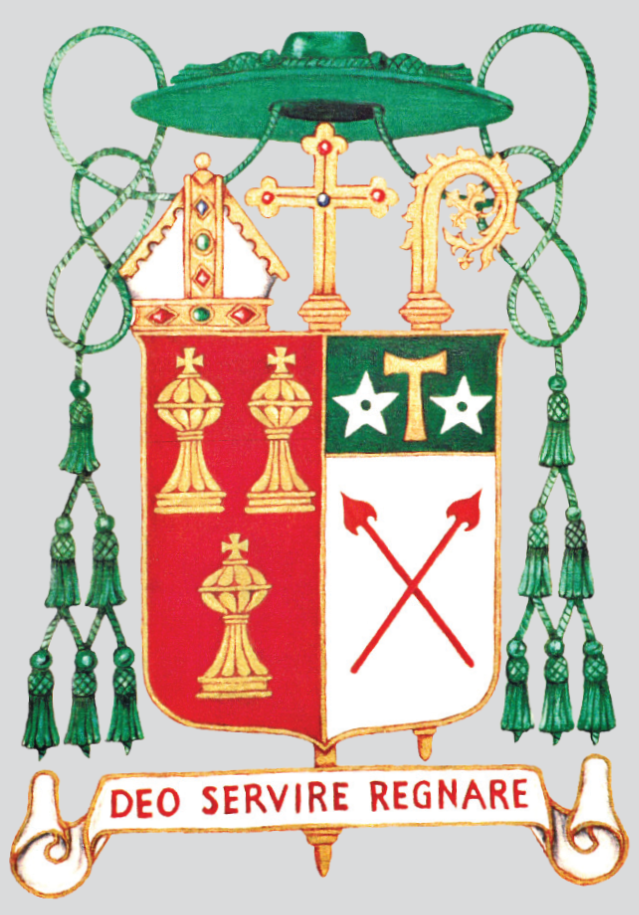
Deo servire regnare

Riferimenti: biografici
scheda di www.catholic-hierarchy.org
pagina di en.wikipedia.org

Riferimenti araldici
stemma della Diocesi di Corpus Christi

Fonti immagini
pagina di www.diocesecc.org

Lo stemma e il motto sono così presentati nella pagina di www.diocesecc.org:
The coat of arms prepared for Bishop Thomas J. Drury when he was consecrated a bishop is made up of a silver field with a green upper partition, bearing a Tau cross and stars, signifying his Irish ancestry as a son of County Sligo.  In the principal portion are two crossed lances.  As the reported instruments of martyrdom of St. Thomas the Apostle, the baptismal patron of Bishop Drury, the lances are tinctured in red, the liturgical color of martyrdom (blood).  The lances also form the Greek letter “Chi,” the initial letter of “Christ,” for whom St. Thomas offered his life.
His motto “Deo Servire Regnare” was taken from the Post-Communion of the Votive Mass for Peace at the time of his consecration as a bishop and is translated “To Serve God is to reign.”
 

Marx, Adolph (1915-1965), vescovo

Adolph Marx
Vescovo ausiliare di Corpus Christi (1956-1965)
Vescovo titolare di Citro (1956-1965)
1° Vescovo di Brownsville (1965)

Plenitudo legis dilectio

Riferimenti: biografici
scheda di www.catholic-hierarchy.org
pagina di en.wikipedia.org

Riferimenti araldici
stemma della Diocesi di Corpus Christi

Fonti immagini
pagina di www.diocesecc.org

Lo stemma e il motto sono così presentati nella pagina di www.diocesecc.org:
The shield of Bishop Marx displays the family arms of the Marx family (the name “Marx” meaning “warrior”) which is described as being composed of a silver field with a black chief (upper compartment) bearing two human arms in natural colors.  These “arms” are shortened to the wrist and fingers of hands “raised in benediction” on the bishop’s coat of arms so that they might more appropriately reflect this pastoral member of the Marx family who is a warrior for Christ but a source of blessing for his brothers and sisters. A central field of blue has been added to display a Silver Star that symbolizes the Lone Star of Texas, where Bishop Marx was called to serve.  The star and colors of silver and blue also reflect his devotion to the Blessed Virgin.
The black upper compartment of the bishop’s arms bears three golden crowns from the coat of arms of Cologne where the bishop was born.  These three crowns celebrate the tradition that the three Wise Men (the Magi Kings) are buried in the Cologne Cathedral.  In this regard the Star of Texas on the shield has a double significance as it also represents the star of Bethlehem that the wise men followed.  The motto “Plenitudo Legis Dilectio” is taken from the epistle to the Romans 13:10 which can be translated “Love is the fulfillment of the law.”  This was especially fitting for Bishop Marx who was a Doctor of Canon Law.

Garriga, Mariano Simon (1886-1965), vescovo

Mariano Simon Garriga
Vescovo coadiutore di Corpus Christi (1936-1949)
Vescovo titolare di Siene (1936-1949)
Vescovo di Corpus Christi (1949-1965)

Sub tutela Matris

Riferimenti: biografici
scheda di www.catholic-hierarchy.org
pagina di en.wikipedia.org

Riferimenti araldici
stemma della Diocesi di Corpus Christi

Fonti immagini
pagina di www.diocesecc.org

Lo stemma e il motto sono così presentati nella pagina di www.diocesecc.org:
To the right in the coat of arms is the personal seal of Bishop Garriga.  The laurel tree was a symbol of Barcelona, and “La Garriga” is a municipality in that area of Spain from which Bishop Garriga’s father came.
The star at the top of the tree represents Our Lady “Star” of the Sea—the parish church in Port Isabel, Texas where Bishop Garriga was baptized.  It also points to the Lone Star State of Texas and is a reminder that Garriga was the first native Texan ordained a bishop in the state.  His motto “Sub Tutela Matris” emphasizes his great devotion to Mother Mary—“Under the protection/guard/guidance of Mother.”


Ledvina, Emmanuel Boleslaus (1868-1952), vescovo

Emmanuel Boleslaus Ledvina
Vescovo di Corpus Christi (1921-1949)
Vescovo titolare di Pitane (1949-1952)

Passio Christi in cordibus nostris

Riferimenti: biografici
scheda di www.catholic-hierarchy.org
pagina di en.wikipedia.org

Riferimenti araldici
stemma della Diocesi di Corpus Christi

Fonti immagini
pagina di www.diocesecc.org

Lo stemma e il motto sono così presentati nella pagina di www.diocesecc.org:
The cross at top is a variation of the cross of St. George and can attest to the bishop’s heritage since the Basilica of St. George in Prague was founded in 920 and was the original burial site of the early Czech martyrs and royal dynasties.  It was intended to be the main sanctuary in Bohemia, where Bishop Ledvina’s father was born.  However, this particular cross consists of a silver field, with a cross of red and blue.  In heraldry “silver” always replaces “white.”  The red, white, and blue cross signifies the Extension Society (of which Bishop Ledvina had been an officer for many years) and its service to the American home missions.
Below the cross are the lilies of France reminding us that Bishop Ledvina was ordained for the Diocese of Vincennes (now the Archdiocese of Indianapolis) a territory settled by the French missionaries and explorers like Joillet and Marquette.  The Carpenter’s Square signifies Bishop Ledvina’s father who was an architect and construction engineer.  Significantly the bishop himself was also known as the “Great Builder” because of the number of churches, convents, rectories and schools he built during his administration–including the present Corpus Christi Cathedral.  The star is the symbol of the Lone Star State as well as a symbol for the Blessed Virgin (Star of the Sea) and rests on a field of blue–the color of water and of the Blessed Mother.  His motto “In Domino Confido” expresses his strong faith in what can be done when we act with God–“I trust in the Lord.”

Nussbaum, Paul Joseph, C.P. (1870-1935), vescovo


Paul Joseph (Henry John) Nussbaum
Congregazione della Passione di Gesù (Passionisti)
1° Vescovo di Corpus Christi (1913-1920)
Vescovo titolare di Gerasa (1920-1922)
Vescovo di Sault Sainte Marie and Marquette (1922-1935)

Passio Christi in cordibus nostris

Riferimenti: biografici
scheda di www.catholic-hierarchy.org
pagina di en.wikipedia.org

Riferimenti araldici
stemma della Diocesi di Corpus Christi

Fonti immagini
pagina di www.diocesecc.org

Lo stemma e il motto sono così presentati nella pagina di www.diocesecc.org:
The coat of arms of Bishop Nussbaum which appears in the stain glass “The Manna in the Desert” contains on the left side the coat of arms of the newly erected Diocese of Corpus Christi–three ciborium (the vessels for holding the Eucharistic Body of Christ) on a field of red that represent the sacrifice of Christ who gave himself Body, Blood, Soul and Divinity in the Eucharist.
To the right on the seal is Bishop Nussbaum’s coat of arms.  The top half of his seal holds the symbol of the Passionist Congregation of which he was a member.  This symbol chosen by St. Paul of the Cross, founder of the Passionist Congregation, includes the branches of the palm and olive.  The palm branch is a reminder of the Passion of Christ and his victory over sin and death.  The olive branch is a reminder of his title as the Christ (the anointed one) since olive oil was used to make chrism by which the chosen were anointed.  Inside the heart (surmounted by a cross) are the words “Jesu XPI (short for “Christi”) Passio”, i.e. the Passion of Jesus Christ.
The lower half of Bishop Nussbaum’s personal coat of arms contains a “walnut tree”—the meaning of his name “Nussbaum” (remember the Christmas carol “O Tannenbaum”—a “fir tree” and hence the kind of evergreen tree used for a Christmas tree).  The motto of Bishop Nussbaum, “Passio Christi in Corporibus Nostris” refers to the words of St. Paul and reminds the members of the Passionist Congregation that we bear “the passion of Christ in our bodies”.

giovedì 30 marzo 2017

González Nieves, fr. Roberto Octavio, O.F.M. (1950- ), vescovo, arcivescovo

Fr. Roberto Octavio González Nieves
Vescovo ausiliare di Boston (1988-1995)
Vescovo titolare di Ursona (1988-1995)
Vescovo coadiutore di Corpus Christi (1995-1997)
Vescovo di Corpus Christi (1997-1999)
Arcivescovo metropolita di San Juan (1999- )

Vita per Jesum


Riferimenti: biografici
scheda di www.catholic-hierarchy.org
pagina di it.wikipedia.org

Riferimenti araldici
stemma Diocesi di Corpus Christi

Il motto e lo stemma sono così presentati nella pagina di arqsj.org:
BLASÓN: Armas de la derecha del escudo (izquierda del espectador):Gules o fondo rojizoBanderín plateadoCordero pascual sobre un semicírculo plateado, teniendo como base cuatro listas onduladas en azulado. Armas de la izquierda del escudo (derecha del espectador):GulesImagen de busto de ntra. madre de la divina providenciaEn lista azul se levanta una paloma con ramo de olivo en su pico entre dos cruces tau, con borde de plata, borrado a la diestra. SIGNIFICADO: SOMBRERO PONTIFICAL: Está adornado con sobrero pontifical con el cordón de diez borlas todo verde. El sombrero pontifical, el número y color de las borlas indicaban el rango del prelado; costumbre practicada aún por la jerarquía eclesiástica. Las diez borlas señalan el rango del prelado particular, que en este caso es el de un Arzobispo. Los términos diestra y siniestra se refieren a la perspectiva del que usaba el escudo como defensa. Por eso están en reversa del espectador. Está coronado con la cruz de una arquidiócesis, con dos barras horizontales, una más corta que la otra. Antes de 1870, este sombrero pontifical se usaba en las solemnes cabalgatas que se llevaban a cabo en inauguraciones y festividades papales.  MITAD DERECHA: Parte izquierda del espectador, muestra las armas de la arquidiócesis de san juan de puerto rico. estas armas tienen fondo rojizo. El Cordero Pascual simboliza directamente a Cristo e indirectamente a San Juan Bautista, quien, siendo el precursor del redentor, proclamaba: "He aquí el Cordero de Dios". San Juan Bautista es el principal patrono de la Arquidiócesis de San Juan y la ciudad sede de la Arquidiócesis que lleva su nombre.
BASE ONDULADA: La base ondulada, sobre la que descansa el Cordero, significa que San Juan es una ciudad en una isla. El uso de los colores rojo, blanco y azul representan a la Santísima Trinidad y los colores en sí recuerdan los colores de la bandera puertorriqueña.
MITAD IZQUIERDA: Parte derecha del espectador, son las armas personales del Arzobispo González. Muestra en esta parte la imagen de la madre de la Divina Providencia, que es la celestial "...y principal Patrona de toda la nación puertorriqueña" (Papa Pablo VI, 19 de noviembre de 1969.)
LA VIRGEN: Santa María está sobre un fondo rojo que se refiere al Espíritu Santo de pentecostés. La lista azul sobre la imagen simboliza la verdad y la fidelidad y tiene dos cruces tau doradas que son el emblema de la Orden Franciscana a la cual pertenece el Arzobispo.
LA PALOMA: Con el ramo de olivo en el pico es un símbolo particular de su propia familia. El hecho de que la paloma "se levanta" sugiere la disponibilidad para llevar el Evangelio del príncipe de la paz. El borde blanco plateado que rodea esta parte del escudo significa que el gozo de la Resurrección nos debiera circundar a todos. El borde, por razones estéticas, no rodea toda la parte izquierda del escudo. El juntar el escudo de armas personal del Arzobispo con el escudo de armas de la Arquidiócesis significa el vínculo nupcial o Matrimonio Espiritual del ordinario con su Diócesis y, por tanto, simboliza su amor por el pueblo que le ha sido encomendado por Dios.
El escudo de armas para el Arzobispo fue creado por el Revdo. Padre James Parker, presbítero de la diócesis de Charleston, asistente al delegado eclesiástico de la santa sede. Fué confeccionado cuando Monseñor González Nieves era Obispo Auxiliar de Boston.
El Padre James es miembro de la Sociedad Heráldica de Canadá y de la Sociedad Heráldica de Estados Unidos de Norteamérica. La composición artística fue diseñada por el Padre Larry D. Lossing, Presbítero de la Diócesis de Orlando en Florida.
Traducción al español a cargo de Mons. Fernando B. Felices Sánchez, Presbítero de la Arquidiócesis de San Juan de Puerto Rico.

Ultimo aggiornamento: 30 ottobre 2017